
Why Full Pipelines Still Miss Revenue Targets
You’ve put in the effort. The pipeline is full, deals at different stages, named opportunities, a forecast that on paper should deliver results.
Then the quarter ends. And the number isn’t there
If you’ve experienced this, or are seeing it now, you know how uncomfortable it feels. An empty pipeline is painful, but at least clear. When a full pipeline doesn’t convert, it’s confusing. Something’s wrong, but nothing seems obviously broken.
This sense of confusion often marks the turning point: what seems like a straightforward issue with numbers turns out to require deeper investigation.
Because the problem isn’t that your pipeline is full. The problem is that your pipeline may not be real.
The Most Dangerous Pipeline Is the One That Looks Healthy
There’s a belief that runs through most B2B sales organizations: more pipeline equals more revenue. Fill the top, protect the bottom, and eventually the math works out.
That belief breaks down around $5M to $20M in revenue, when teams realize opportunity quality and integrity matter far more than volume.
of sales reps missed their quota last year, and 67% don’t expect to hit it this year.
Source: Salesforce, State of Sales, 6th edition (survey of 5,500 sales professionals across 27 countries), July 2024
The hard truth is that most missed quarters aren’t due to a weak top of funnel. They happen because deals were counted before they were truly real.
Addressing this core issue is crucial before making any changes. Next, let’s reframe how you view pipeline coverage and forecasting.
Pipeline Coverage Is Not a Forecast
Before diagnosing where deals are leaking, a conceptual shift is needed.
Pipeline coverage — the ratio of pipeline value to your revenue target — is a measure of capacity. It shows if you have enough potential to reach your goal, but it doesn’t predict whether you actually will.
Most teams treat coverage like a forecast. It’s not.
The Coverage vs. Conversion Distinction
Pipeline coverage = Do we have enough volume in the funnel?
Pipeline conversion = Are the right deals advancing at the right rate?
Coverage tells you how much you have. Conversion tells you how real those deals are. Many forecasting problems happen when teams confuse the two.
A team with 4× pipeline coverage and a 15% conversion rate differs greatly from one with 2× coverage and a 45% conversion rate — even with less pipeline. The second team’s more honest, higher-quality pipeline increases their chances of hitting the number with less stress.
of B2B purchases stall at some point during the buying process.
Source: Forrester Research, State of Business Buying, December 2024 (16,000+ global business buyer responses)
That’s not a pipeline volume problem. It’s a pipeline integrity problem. Most deals don’t fail because demand disappeared. They fail because the internal conditions required to close them were never secured.
The goal isn’t just to have more pipeline. It’s to have a pipeline that consistently converts. Prioritize pipeline quality to achieve predictable results.
Five Hidden Reasons Full Pipelines Miss Revenue Targets
Most revenue misses that begin with a “full pipeline” come from one or more hidden structural problems. These issues aren’t always obvious — but they can be fixed. Spotting these hidden causes is the first step to solving and preventing future misses.
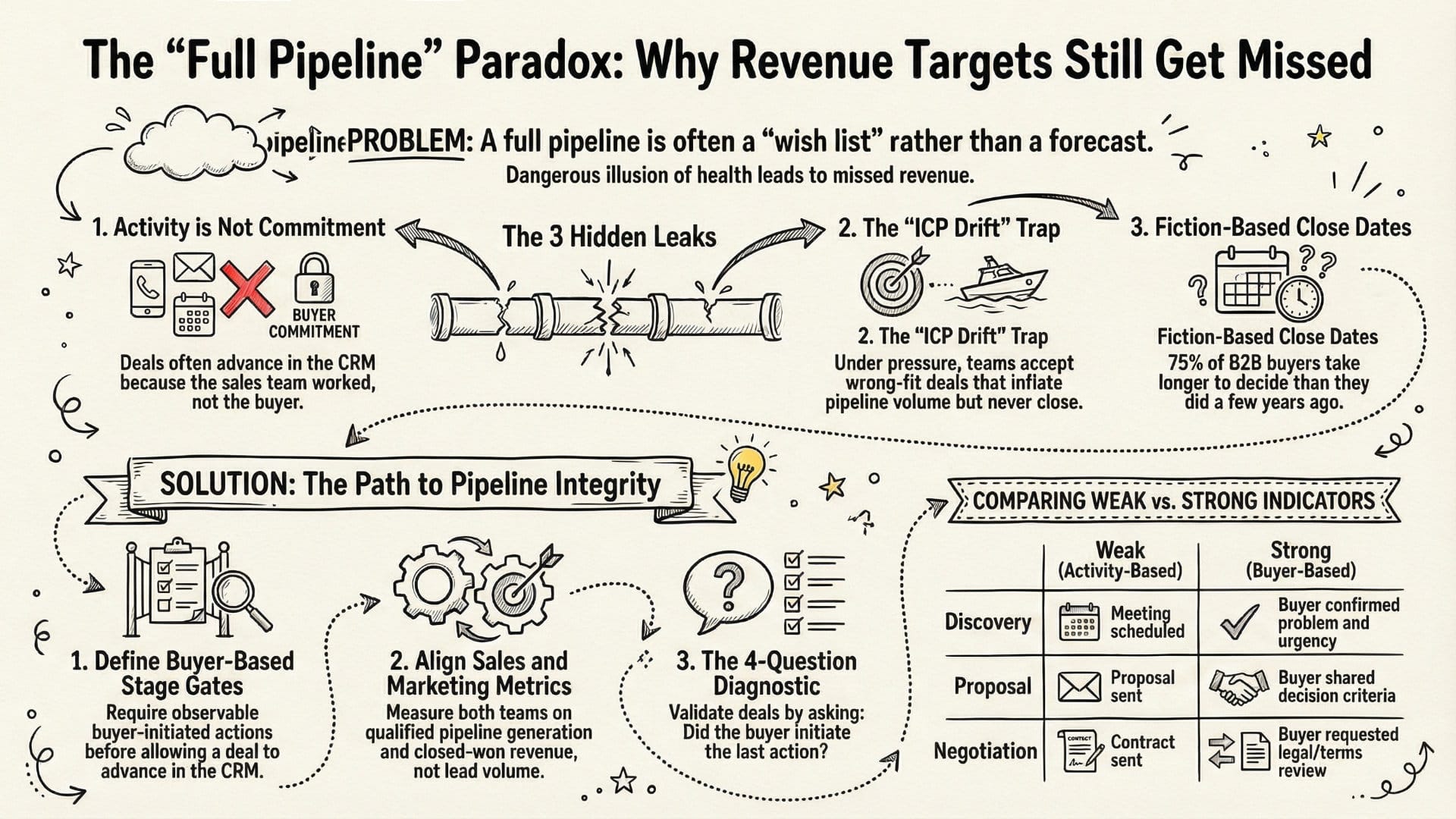
Deals Are Advancing Without Real Buyer Commitment
The most common cause of pipeline inflation is also the hardest to spot: deals move forward because your team moved them forward, not because the buyer is actually making progress.
Stages are updated, CRM records are changed, probability scores increase. But none of this shows what the buyer is really doing.
In complex B2B sales, a champion who loves your product may be sitting next to a compliance lead who can quietly slow everything down. A budget holder who approved spending may have a colleague who fears implementation risk. None of that shows up in the pitch conversation. It shows up in the silence afterward.
When was the last time the buyer took an action that moved the deal forward instead of your team?
If your activity log mostly shows your team’s actions, the deal might be moving in your CRM but not in real life.
What healthy buyer commitment looks like
- The buyer requested a follow-up meeting unprompted.
- Internal stakeholders were introduced voluntarily by the prospect.
- The buyer shared internal timelines, constraints, or budget context.
- Legal or procurement was engaged by the buyer’s side.
If you don’t see these signals, deals that seem late-stage to you might still be early-stage for the buyer. Align each stage with evidence from buyer actions.
Pipeline Clarity CheckStage Definitions Are Assumptions, Not Agreements
If you ask five people on your team what “Proposal Sent” or “In Negotiation” means, you’ll probably get five different answers.
This is not a people problem. It’s a systems problem.
When stage definitions aren’t clear, deals move forward based on your team’s activity instead of the buyer’s actions. A proposal is sent and the deal advances — even if the buyer hasn’t opened it, shared it, or confirmed they want to move ahead.
The fix isn’t complicated, but it requires discipline: each pipeline stage needs an entry criterion that is observable and buyer-driven, not activity-driven.
A practical framework for stage integrity
| Stage | Activity-Based (Weak) | Buyer-Based (Strong) |
|---|---|---|
| Discovery | Meeting scheduled | Buyer confirmed problem and expressed urgency |
| Proposal | Proposal sent | Buyer requested proposal and shared decision criteria |
| Evaluation | Follow-up sent | Buyer introduced additional stakeholders or shared timeline |
| Negotiation | Contract sent | Buyer requested legal review or raised specific terms |
If stages are based on your team’s actions, the pipeline shows your team’s effort. If stages are based on what the buyer did, the pipeline shows buyer momentum, which is what really predicts a close.
ICP Drift Has Inflated the Pipeline with Wrong-Fit Deals
Over time, under pressure to meet quotas, most B2B sales teams begin to accept deals they shouldn’t.
A rep is three weeks from end of quarter. A deal comes in from a company outside the ideal customer profile. It’s in the wrong industry, wrong size, wrong buying process, but it looks big enough to matter. It gets logged. It moves forward. It eventually stalls, dies, or closes at a fraction of the expected value.
This is ICP drift: the quiet erosion of qualification standards that inflates pipeline with deals that were never going to close the way they were forecast.
The lesson isn’t that less pipeline is better. It’s that a smaller, better-qualified pipeline outperforms a larger, poorly-qualified one.
ICP drift is dangerous because it’s invisible in aggregate. Although your pipeline appears full and stage distribution looks normal, quality has eroded — putting you at risk of missing revenue targets before the shortfall surfaces. Surface early warning signs, not just aggregate data, to catch problems before they impact revenue.
ICP drift may be inflating your pipeline if:
- Win rates are declining even as pipeline volume holds steady.
- Average sales cycle length is increasing across the board.
- “Stalled” deals cluster in specific industries, segments, or deal sizes.
- Reps are spending more time on fewer closes.
Revenue Timing Assumptions Are Optimistic
Every pipeline has a column for “expected close date.” In most B2B organizations, that column carries a lot of weight, but it’s rarely accurate.
Close dates are set when deals are created, pushed back when deals stall, and updated to align with the quarterly forecast. This leads to a pipeline where timing assumptions don’t reflect how buyers actually make decisions.
people are now involved in the average B2B purchase, and 89% of purchases span two or more departments. Budget constraints and continued economic uncertainty mean buying decisions are being delayed as the norm, not the exception.
Sources: Forrester, State of Business Buying 2023 (18,000+ respondents) & 2024 (16,000+ respondents)
More decision-makers mean more private opinions, and more chances for your timing assumptions to be wrong before a deal even gets to negotiation.
When your revenue timing is off, your forecasts are off. Even if your pipeline volume is right. If you expect a deal to close in Q2 but it actually closes in Q3, that’s not a pipeline problem. It’s a timing assumption problem. The result, however, is the same: a missed quarter that looked like it should have been a win.
- “They told us Q2” — Buyers often give optimistic timelines based on best-case scenarios, not real buying processes. Budget cycles, internal reviews, and procurement steps usually add 30 to 90 days.
- “It’s been in negotiation for two weeks” — Negotiation is one of the least predictable stages in B2B sales. Legal reviews alone can take longer than the entire sales cycle before them.
- “It’s a renewal, so it should be fast” — Renewal deals often feel safe but carry hidden risk. Stakeholder changes, competitive reviews, and budget realignments all happen at renewal time.
A forecast built on optimistic timing assumptions isn’t a forecast. It’s a wish list.
Marketing and Sales Are Measuring Different Things
This issue isn’t about individual deals. It’s about the bigger misalignment that creates a weak pipeline from the start.
When marketing is measured by MQL volume and sales by closed revenue, the two teams are optimizing for different outcomes. Marketing fills the funnel with leads that hit the MQL threshold. Sales receives those leads, finds that most don’t meet their actual qualification bar, and either burns time chasing them or ignores them.
When marketing and sales align to the same metric, i.e. qualified pipeline generation and closed-won revenue, behaviour changes immediately. Marketing stops spending budget on generic awareness campaigns and starts building targeted plays designed to break into accounts that sales actually wants to close.
Does your definition of a qualified lead come from marketing’s threshold or from analyzing your actual closed-won deals?
If it’s the former, your pipeline is being filled based on assumptions that may not reflect how your best customers actually behave.
The pipeline appears full because marketing is sending leads. But revenue is missed because those leads weren’t truly sales-qualified. This isn’t about blaming anyone, it’s about fixing the system. The solution is to agree on what a qualified opportunity really means: not by lead score, but by behaviours that match closed deals.
The Pipeline Integrity Diagnostic: A Simple Self-Assessment
Before you invest in more outreach, new channels, or more pipeline volume, run this diagnostic on your current pipeline.
For each active opportunity, answer these four questions:
1. What is the last buyer-initiated action on this deal?
Not your team’s. The buyer’s. If you can’t answer this, the deal may not be active.
2. Do you know who all the decision-makers are, and have you spoken with more than one of them?
In B2B, most stalled deals are due to stakeholders your team hasn’t yet identified.
3. Does the close date match how this buyer really makes decisions or is it set to fit your team’s quarterly goals?
Adjust close dates based on buyer behaviour, not just forecast needs.
4. If this deal disappeared from your pipeline tomorrow, would you be surprised or would you quietly understand why?
Your honest answer to this question is usually more accurate than your CRM.
Most teams that run this exercise discover that 20–40% of their “active” pipeline is actually stalled, wrong-fit, or advancing based on seller activity rather than buyer momentum.
That’s revenue that’s already leaked out before the quarter even ends.
Why This Problem Compounds Over Time
A pipeline integrity problem doesn’t stay the same size. It gets bigger over time.
Every quarter, stalled deals roll over. New deals come in under the same conditions that let the bad ones through. The team works harder, chasing more volume to make up for low conversion rates. More activity. More pipeline. Same missed targets.
The instinct in most B2B organizations when growth stalls is to turn up the dial: revenue is down, so add more pipeline; pipeline needs to grow, so generate more leads; leads aren’t coming fast enough, so spend more on ads and hire more reps. This volume-era thinking assumes the answer is always more, and it’s exactly what compounds the miss.
This is the trap: treating a conversion problem like a volume problem. Adding more pipeline to a broken system doesn’t fix it. It just means there’s more at risk.
The teams that break out of this cycle do so by stopping, diagnosing the actual source of the miss, and fixing the structural issue before adding more volume on top of it.
What Fixing This Actually Looks Like
There’s no one-size-fits-all solution to pipeline integrity problems. The root cause varies by organization. Still, the process to fix it usually follows the same steps:
Audit what’s really in the pipeline. Don’t just look at what’s in the CRM. Talk honestly with the reps who own the deals. What has the buyer actually done lately? What are the real blockers?
Recalibrate your ICP and qualification criteria. Use data from closed-won deals, not guesses. Which deals closed fastest? Which had the highest lifetime value? Which returned for renewals? That’s your real ICP.
Set stage exit criteria that depend on buyer actions. Each stage should only advance if the buyer has taken at least one clear step. If not, the deal stays put.
Make sure marketing and sales agree on what “qualified” means. Build this definition using closed-won data, not just marketing’s lead scoring.
Build forecasting habits that use leading indicators, not lagging ones. Pipeline velocity, deal age by stage, and buyer-initiated touchpoints are better predictors of close than deal size and close date alone.
The Real Question Isn’t “Why Didn’t We Hit the Number?”
It’s really: What was in that pipeline that we were counting on, and should we have been?
Revenue misses are almost always diagnosable in hindsight. The deals that didn’t close had signals that, in retrospect, were clear. The qualification was soft. The buyer commitment wasn’t there. The close date was optimistic. The deal sat in a stage too long without movement.
The goal of pipeline integrity work is to spot those signals before the quarter ends, not after. That way, your forecast is honest, your team focuses on the right deals, and your revenue number is based on real opportunities.
A full pipeline is a starting point, not a guarantee.
Not Sure If Your Pipeline Can Actually Close?
A full pipeline doesn’t mean a healthy pipeline. The Pipeline Clarity Check is a focused audit that shows whether your current opportunities can actually close, and exactly where revenue is quietly leaking before it shows up as a missed quarter.
You’ll come away with a clear view of your pipeline’s health, where qualification gaps exist, and which fixes will have the quickest impact on revenue.